
Contents
1. Note Values 2. Bars and Time Signatures 3. Pitch Names 4. Staves and Clefs 5. Staff Notation 6. Ledger Lines 7. Sharps, Flats, and Naturals 8. Semitones, Whole Tones, and the C Major Scale 9. G Major, D Major, and F Major Scales 10. Rests 11. Ties and Dots 12. Tonality and Key Signatures 13. Accidentals 14. Scale Degrees 15. Tonic Chords 16. Intervals 17. Beaming Notes within a Bar 18. Performance Directions
ABRSM Grade 1 Knowledge Points
View Contents
When listening to music, people often "tap along with the beat", especially when listening to marches or dance music, tapping to the steady beat of the piece. In the Grade 1 course, beats are presented as follows:
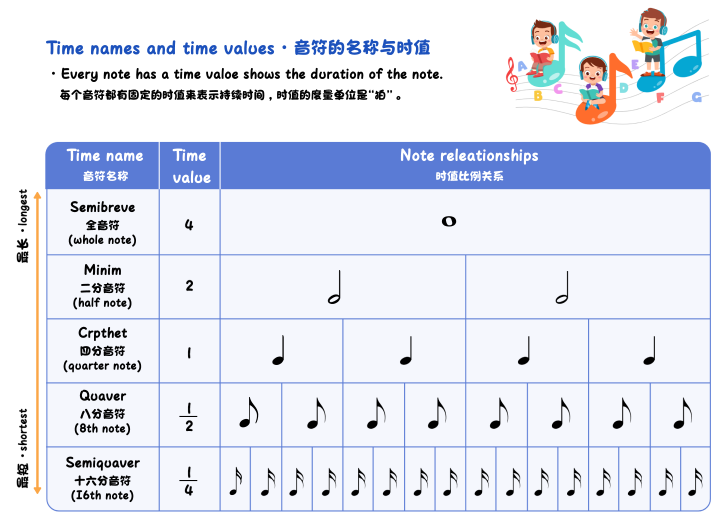
Figure 1: Names and values of notes
The duration of one whole note is equal to 2 half notes or 4 quarter notes; we can also say that one whole note is "equal in value" to 2 half notes and 4 quarter notes. One quarter note is equal to 2 eighth notes, or 4 sixteenth notes.
Systematic Learning to Help You Pass the ABRSM Exam
Download the app to practice anytime, anywhere. Master key exam points easily and see steady improvement in your scores.

