
"Semitone" and "whole tone" are used to describe adjacent notes on a keyboard. But intervals can also be expressed using numbers, so that you can describe the interval between any two notes. The "number" of an interval is in fact the number of scale degrees it contains — we can also describe it as the total number of letter names included.Figure 47:


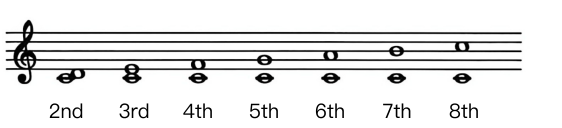
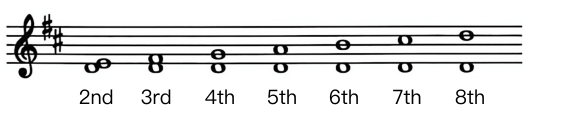
In Grade 1, the lower note of an interval is always the tonic of one of the scales you have learned (C, G, D or F). So, for example, if the higher note is the 5th degree, then the interval is a 5th. The Grade 1 exam only includes intervals of an octave or less. Figure 48 shows all the intervals in the Grade 1 course, displayed using the treble clef:


If the two notes of an interval are played at the same time, this is a "harmonic" interval. If the two notes are played one after the other, it is a "melodic" interval. As shown in Figure 49:


