
Contents
1. Note Values 2. Bars and Time Signatures 3. Pitch Names 4. Staves and Clefs 5. Staff Notation 6. Ledger Lines 7. Sharps, Flats, and Naturals 8. Semitones, Whole Tones, and the C Major Scale 9. G Major, D Major, and F Major Scales 10. Rests 11. Ties and Dots 12. Tonality and Key Signatures 13. Accidentals 14. Scale Degrees 15. Tonic Chords 16. Intervals 17. Beaming Notes within a Bar 18. Performance Directions
ABRSM Grade 1 Knowledge Points
View Contents
Beats in music form groups — most commonly in groups of two, three, or four. The first beat of each group usually feels stronger than the others. When we write these notes, a vertical line is drawn at the end of each group, as shown in the figure:
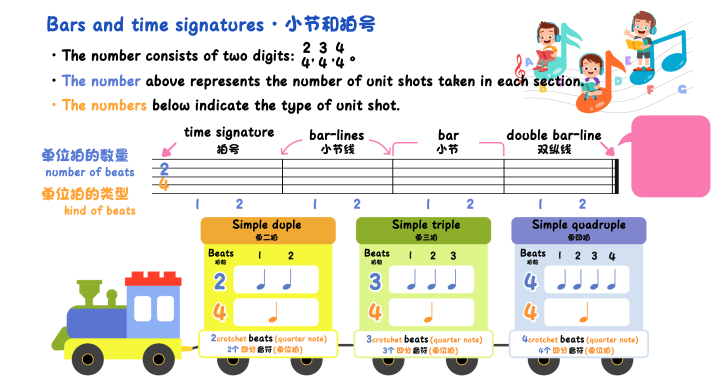
Figure 2: Bars and time signatures
These groups are called bars, and we call this vertical line a barline. Remember that the first beat of each bar — that
is, the first note after the barline — must be played with a stronger feeling than the other notes. A time signature is placed at the beginning of every piece.
In Grade 1, we will use three time signatures (
 ,
,
 and
and
 ).
).
 is commonly called "four-four time", and we may replace
with the symbol c.
is commonly called "four-four time", and we may replace
with the symbol c.
(1)
time: means there are 2 quarter notes in each bar
time: means there are 2 quarter notes in each bar
(2)
time: means there are 3 quarter notes in each bar
time: means there are 3 quarter notes in each bar
(3)
time: means there are 4 quarter notes in each bar
time: means there are 4 quarter notes in each bar Alternatively:
 time: each beat is a quarter note, with 4 beats per bar.
Systematic Learning to Help You Pass the ABRSM Exam
Download the app to practice anytime, anywhere. Master key exam points easily and see steady improvement in your scores.

