
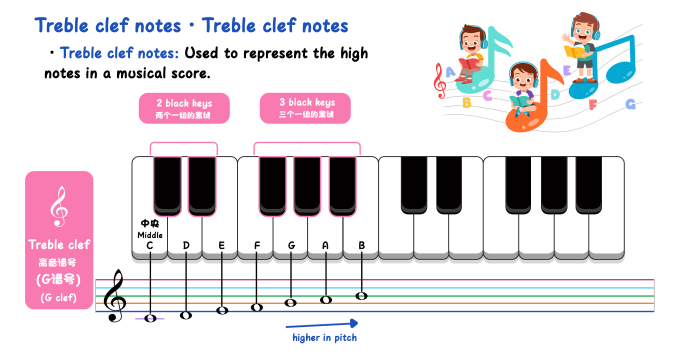
When we write down music, these notes (A, B, C, etc.) are written on five parallel lines, which we call the stave. Each line, as well as each space between the lines, represents a note, as shown in the figure:

When musicians say a note is "on a line", they mean that the line passes through the note. The lines and spaces of the stave are counted starting from the bottom line. "The second line of the stave" refers to the second line counting from the bottom, while "the fourth space" refers to the space between the top two lines.
In the Grade 1 course, only the two most common clefs appear: the treble clef, used for high pitches, and the bass clef, used for low pitches. The treble clef is also known as the "G" clef, because it loops around the second line, which represents the note G.
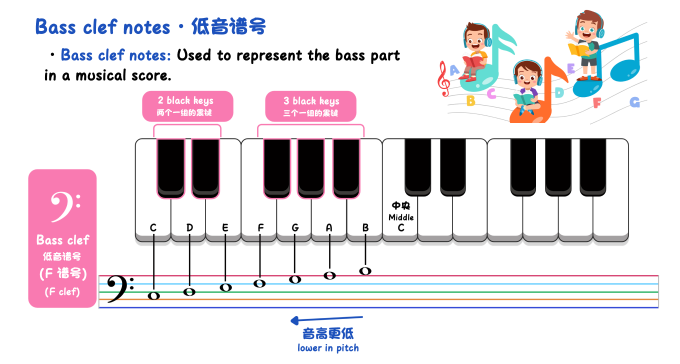
Generally, the bass clef is written as an F clef, a symbol with two dots at its end. These two dots are placed on either side of the fourth line, which represents the note F — which is why the bass clef is also called the "F" clef.

